

December classrooms often include learners who need very different kinds of practice. Some are building their first CVC words; others are ready to explain a past-tense question or use grammar clues to investigate a mystery. A shared Christmas theme can bring the lessons together while each group works toward an appropriate goal.
This guide helps you choose a Christmas literacy or grammar activity, teach a short warm-up, and follow the game with a useful independent check. Select one pathway for your class rather than trying to complete every resource before winter break.
Choose the skill before choosing the adventure
| Learning focus | Christmas resource | Suggested audience |
|---|---|---|
| CVC blending and word building | Help Santa Save Christmas! | Kindergarten–Grade 1 |
| Mixed short-vowel review | The Christmas Tree Surprise | Kindergarten–Grade 1 |
| Past statements, questions, and negatives | The Mixed-Up Christmas Party | Grades 2–4 |
| Parts of speech and reading for evidence | Santa’s Missing List | Grades 2–4 |
Use these grade bands as a starting point. Preview the language and match the level of support to your learners, particularly in ESL and ELL groups.
1. Build and blend with Help Santa Save Christmas!
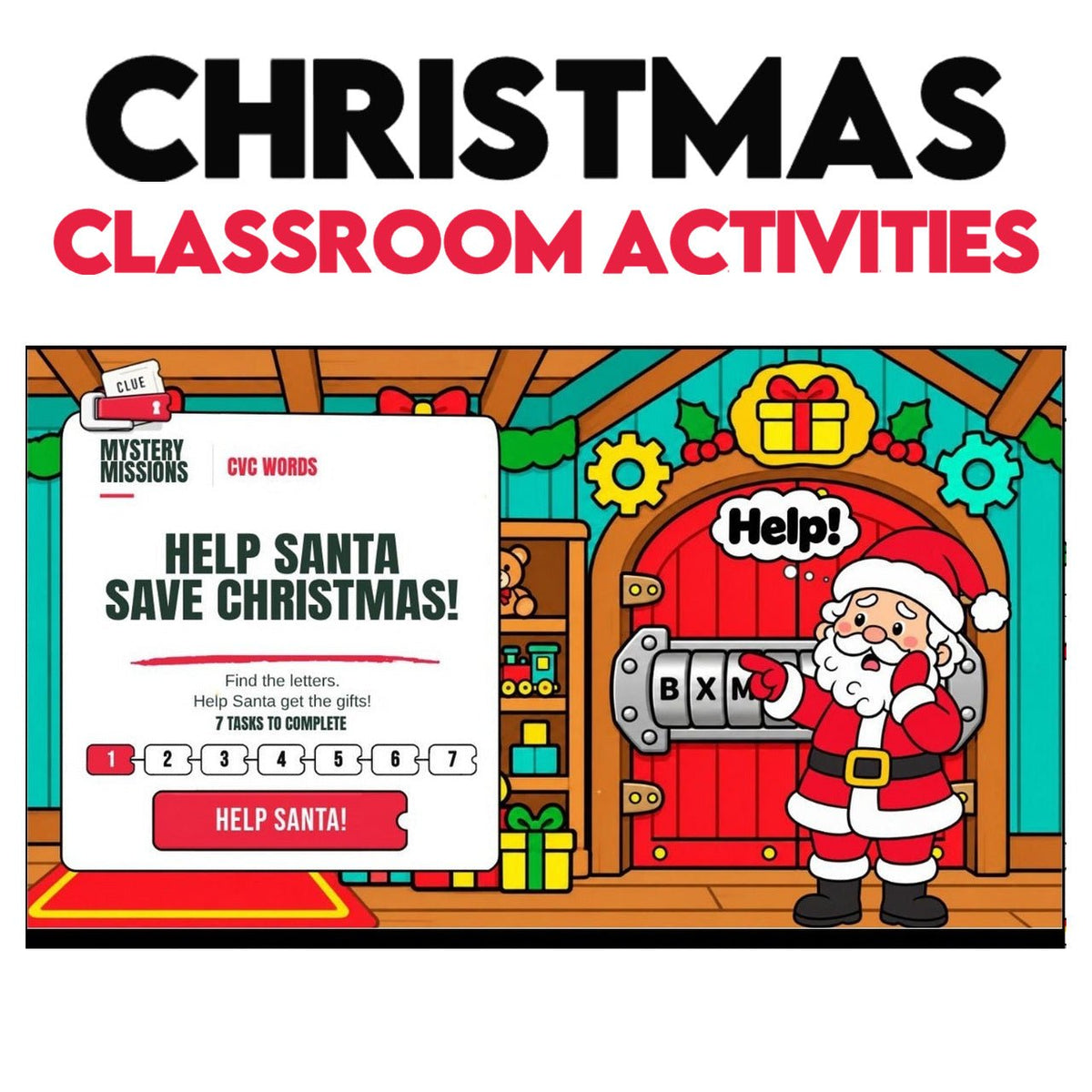
Santa cannot reach the gifts in his secret present room after a snowstorm scatters the code letters. Students complete seven picture-supported phonics activities and recover letters for the final lock. The mission practices CVC decoding, short vowels, word building, and word-picture connections.

Before playing, model a familiar word with paper letters. Say the sounds, place the letters, and blend the whole word. Afterward, dictate a different word using taught correspondences. Ask the learner to build it and read it back. This checks spelling as well as recognition.
2. Revisit short vowels with The Christmas Tree Surprise
In this alternative CVC adventure, students help recover seven missing ornaments and solve a code to turn on the North Pole tree lights. Choose it for another opportunity to apply familiar phonics patterns in a different story.

Try a short teacher-created warm-up with cat and cot. Compare the middle sound and letter, then read both words again. During the mission, listen to occasional responses before students select an image. After play, ask each learner to read a new appropriate word without a picture clue.
3. Investigate past-tense forms at the Christmas party
The Case of the Mixed-Up Christmas Party asks students to investigate missing supplies through seven grammar and reading challenges. Its focus includes regular and irregular past forms, questions with did, and negatives with didn’t.

Use a teacher-created model such as “The elf carried a box.” Change it to “Did the elf carry a box?” and “The elf didn’t carry a box.” Highlight how the base verb follows did and didn’t. Give partners a new sentence to change before beginning the investigation.
For the follow-up, ask learners to write one statement, one question, and one negative about an imagined party. Check the verb pattern and the meaning of each sentence.
4. Explain word choices in Santa’s Missing List
Students investigate seven elves and follow evidence to Santa’s missing gift list. The mission brings together Christmas vocabulary, nouns, verbs, adjectives, prepositions, subject–verb agreement, and reading for evidence.

Start with a complete teacher-created sentence: “The elf carries a small box.” Ask which word names the character, which expresses the action, and which describes the box. Use objects to model “The box is under the chair.” Students can then connect a place expression with something they can see.
During the game, vary your prompts: “What does this word do in the sentence?” checks grammar, while “Which detail supports your answer?” checks comprehension. Finish with a new sentence to discuss independently.
A teacher’s perspective: make partner turns meaningful
Give partners different responsibilities and switch them regularly. One reads or explains; the other checks the letters, sentence pattern, or story evidence. Both students need thinking time before anyone enters an answer. A shared device works best when the conversation remains shared too.
Prepare school access before the lesson
Mystery Missions are online mystery/escape games that can be played individually, with partners or small groups, or together as a teacher-led class. Follow the resource’s activation instructions, generate a classroom code, and let students join with a nickname or team name. Students do not need email accounts.
Use an internet-connected desktop, laptop, Chromebook, or compatible tablet. The games are not designed for phones. Test Mystery Missions on your school device before purchasing. Preview your chosen mission and reserve a full lesson block, with extra time for joining and follow-up if needed.
Preview unfamiliar seasonal vocabulary and explain the story as fiction. Students can discuss the shared characters and setting without needing to describe a Christmas celebration in their own home.
Optional Amazon classroom tools
As an Amazon Associate I earn from qualifying purchases. The links below are affiliate links.
Learning Resources Hand Pointers
Use a pointer to track a displayed word or highlight a detail in a shared sentence. Invite the reader to explain the selected letter or word before passing the pointer to the next student.
View Learning Resources Hand Pointers on Amazon
Learning Resources Recordable Answer Buzzers
Add a turn-taking cue to a teacher-led review round. Give everyone thinking time, select a team, and have students explain their answer before using the buzzer. Keep the focus on a thoughtful response rather than speed.
View Learning Resources Recordable Answer Buzzers on Amazon
Both tools are optional. A finger for tracking and a spoken turn cue work with the same routines.
Frequently asked questions
Which Christmas mission should I choose first?
Choose a CVC adventure for learners applying taught short-vowel patterns. Choose a grammar mystery when students are ready to read its sentences and revisit its target language.
Can I use a mission with the whole class?
Yes. Lead the story from a shared screen and give every learner a way to respond, such as a spoken rehearsal, paper answer, or partner explanation before the class submits a choice.
How can I tell what students learned?
Use a fresh word or sentence after play. Ask learners to read, build, write, or explain it independently, then use those responses to choose the next lesson.
Explore the linked previews above to choose a Christmas adventure that fits your next teaching goal.


