

How Prediction Activities Strengthen Reading Comprehension and Speaking Skills

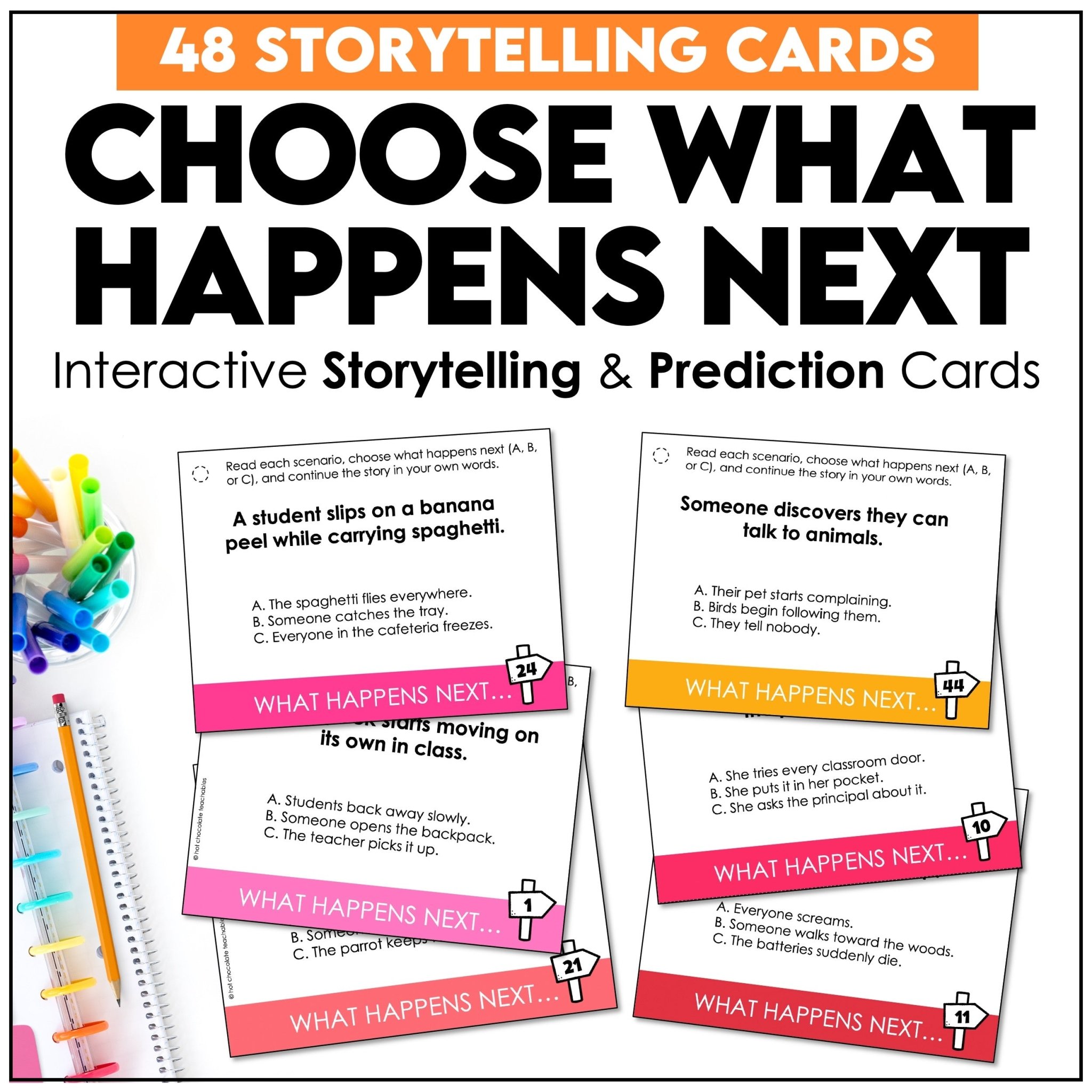
If your students struggle to come up with ideas during speaking or writing time, give them a story choice to start with. These Choose What Happens Next task cards give students a short scenario, three possible directions, and a clear reason to talk. Students choose option A, B, or C, explain their thinking, and continue the story in their own words.
This format is perfect for ESL speaking practice, creative writing centers, mixed-level classes, and students who need support with prediction, inferencing, and storytelling.
Get the resource here: Choose What Happens Next Task Cards on Hot Chocolate Teachables or Choose What Happens Next Task Cards on TPT.
Why Prediction Activities Work So Well
Prediction is not just guessing. When students predict what happens next, they look for clues, think about cause and effect, and explain why one outcome makes sense. That makes this a strong activity for reading comprehension, speaking, and writing.
These prediction task cards help students practice:
- Inferencing: using clues from the scenario
- Critical thinking: choosing the most logical next step
- Storytelling: continuing a story with a clear sequence
- Speaking fluency: explaining ideas in complete sentences
- Creative writing: turning a prompt into an original ending
What Are Choose What Happens Next Task Cards?
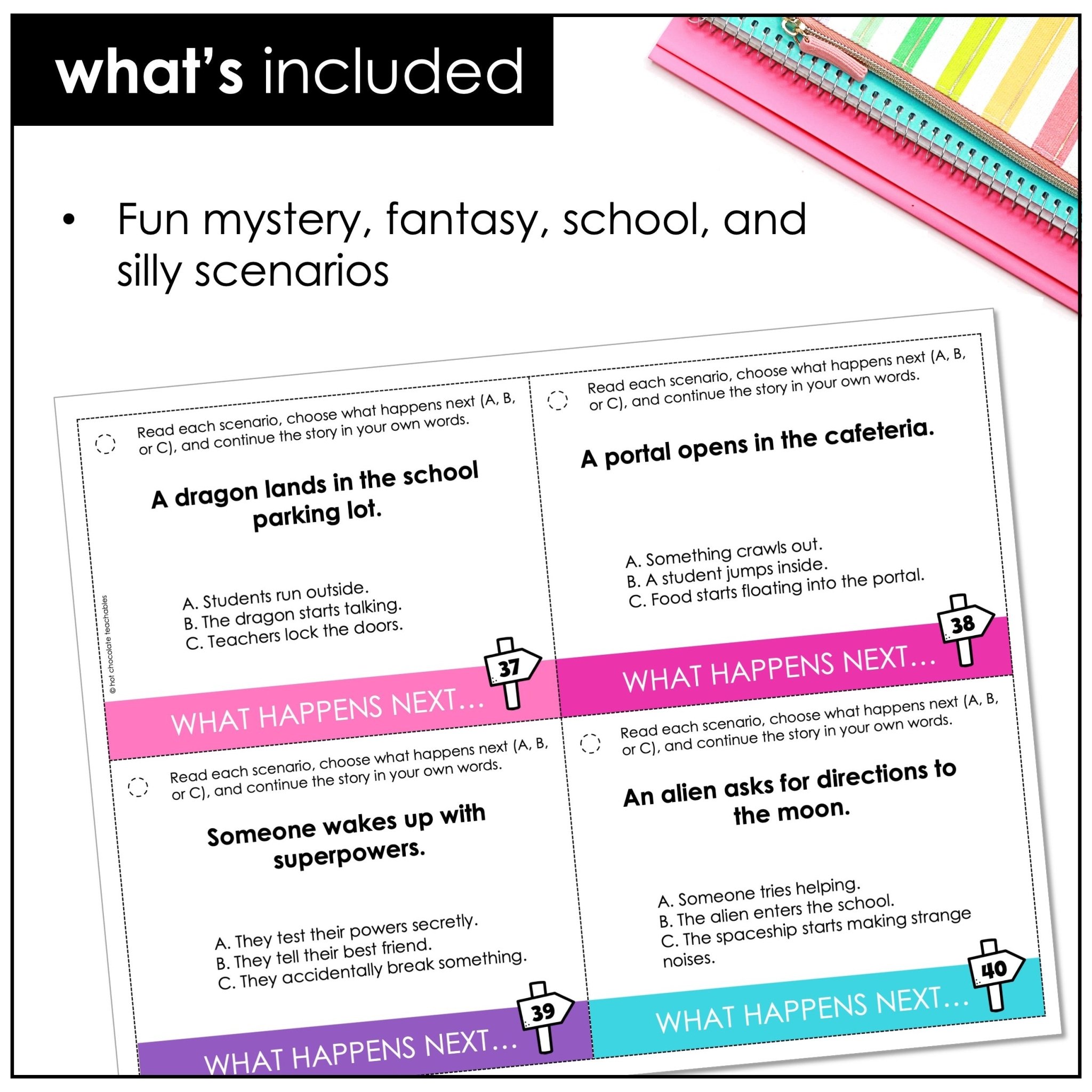
Choose What Happens Next task cards are open-ended storytelling cards. Each card includes a short story situation and three choices for what could happen next. Students pick one option and then explain or write what happens after that.
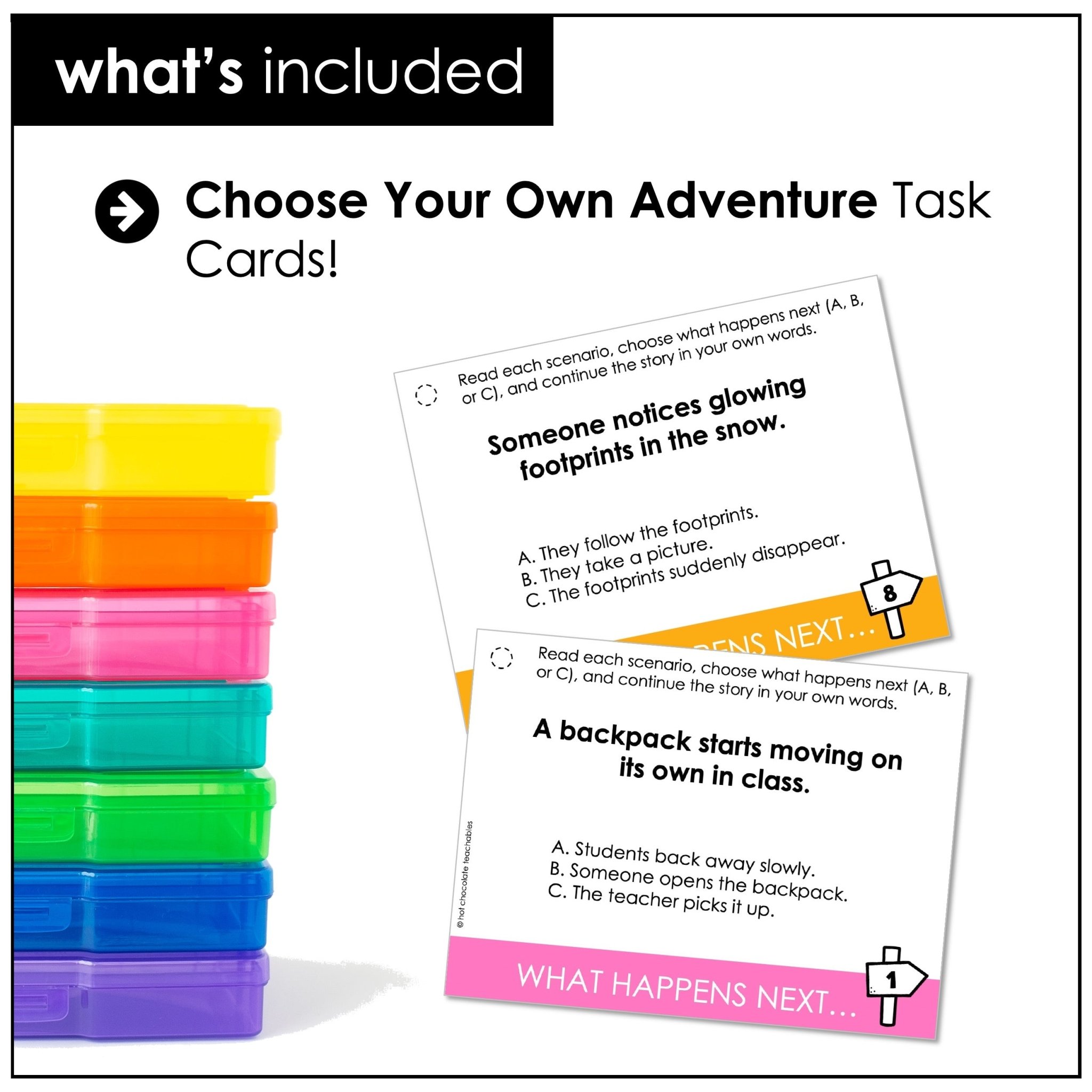
They feel a little like choose your own adventure task cards, but they are designed for classroom use. Students do not have to create a story from scratch. They begin with a clear situation, make a choice, and continue from there.
How the Activity Works
The routine is simple enough for students to learn quickly and reuse all year.
- Time needed: 10–20 minutes for speaking or 20–35 minutes for writing
- Prep: print, cut, and laminate if desired
- Materials: task cards, timer, notebook or recording sheet
- Read the scenario.
- Choose what happens next: A, B, or C.
- Explain the choice using a sentence frame.
- Continue the story with a few spoken or written sentences.
- Share and compare different endings.
Helpful sentence frames
- I choose ___ because ___.
- I think ___ will happen next because ___.
- First ___, then ___, and finally ___.
Skills Students Practice
These cards may feel like a game, but they target important speaking, reading, and writing skills.
Speaking and listening
- Explaining choices clearly
- Using complete sentences
- Taking turns in pairs or groups
- Asking follow-up questions
Reading comprehension
- Making predictions
- Using clues from the scenario
- Understanding cause and effect
- Thinking about character actions and consequences
Writing
- Writing story endings
- Using sequencing words
- Adding details
- Creating a clear beginning, middle, and ending
Ways to Use the Cards for Speaking Practice
These speaking task cards work well because students make a simple choice first. That small step lowers the pressure and gives them something concrete to explain.
Partner Talk
- Partner A reads the card.
- Partner B chooses A, B, or C.
- Partner B explains the choice.
- Partner A adds the next sentence in the story.
Small-Group Story Circle
One student reads the scenario. Everyone votes on what should happen next. Then each student adds one sentence to continue the story.
Quick Speaking Challenge
Students choose a card and speak for 30–60 seconds. This is a great warm-up, bell ringer, or informal fluency check.
Ways to Use the Cards for Writing
These cards also make excellent creative writing prompts. Since students already have a scenario and three choices, they spend less time staring at a blank page and more time developing their ideas.
Short story ending
Students choose one card, select A/B/C, and write 6–10 sentences to continue the story.
Expand the moment
Students choose one sentence from their story and add more detail using feelings, actions, and description.
Dialogue practice
Students turn the ending into a short conversation between characters. This is a helpful way to practice quotation marks and speech verbs.
How to Use These Cards with ESL and Mixed-Level Classes
These ESL storytelling task cards are easy to differentiate because all students can use the same card while producing different levels of language.
- Beginners: choose A/B/C and complete one sentence frame.
- Developing students: explain their choice and add 2–3 story sentences.
- Advanced students: add a twist, a problem, or a surprise ending.
Teacher tip: Require “choice + reason + next sentence.” This keeps students from stopping after they choose an answer and helps build stronger speaking output.
What’s Included
This task card set includes everything you need for low-prep prediction, storytelling, and speaking practice.
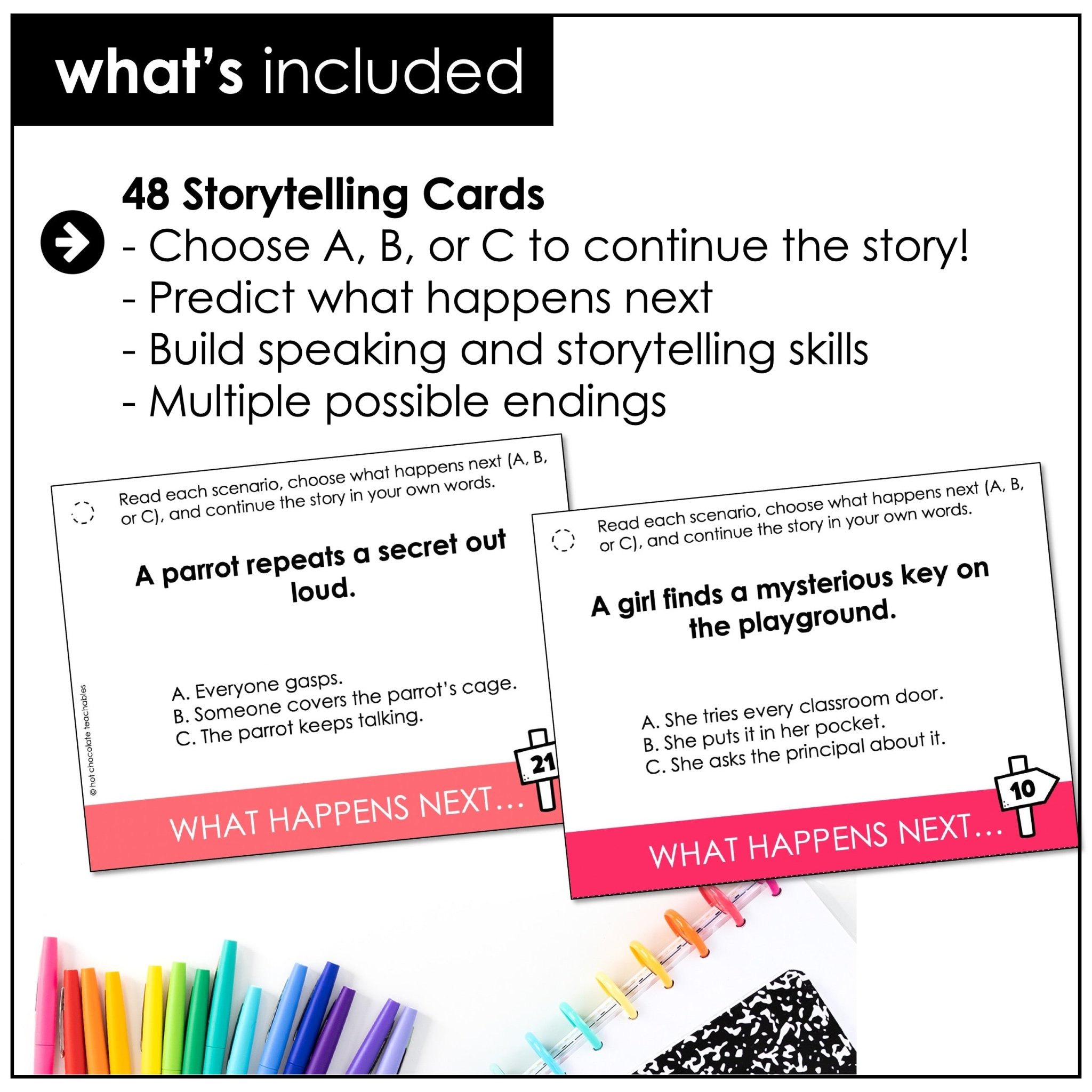
- 48 open-ended storytelling task cards
- Original story scenarios
- A/B/C choices on each card
- Print-and-go format
- Great for speaking, writing, discussion, and centers
Easy Classroom Ideas
- Bell ringer: project one card and have students discuss in pairs.
- Speaking center: students complete three cards with a partner.
- Writing center: students choose one card and write a full story ending.
- Early finishers: students record a short spoken story.
- Small group: use the cards to build complete sentence responses.
- Sub plans: leave cards with a simple speaking or writing routine.
Success looks like this: students can make a prediction, give a reason, and continue the story with a clear sequence.
Shop the Choose What Happens Next Task Cards
- Choose What Happens Next Task Cards on Hot Chocolate Teachables
- Choose What Happens Next Task Cards on Teachers Pay Teachers
More Blog Posts You Might Like
- Five ESL speaking activities that actually get students talking
- Low-prep ESL speaking games for the first week of school
- Teacher Toolkit Membership: unlimited ESL resources for busy teachers
Created by Hot Chocolate Teachables


